

Risk Management · 2025
In this section3 topics
Risk Management Policy & Plan
Policy & Plan Description
2.1 Risk Management Policy and Plan
Chememan Public Company Limited and its subsidiaries (the “Group”) recognize the importance of risk management as a key factor to achieve its business goals. The Board of Directors has established a risk management policy as a guideline for risk management practices. (The Company has published the full version of its risk management policy on its website at www.chememan.com)
Risk Management Structure
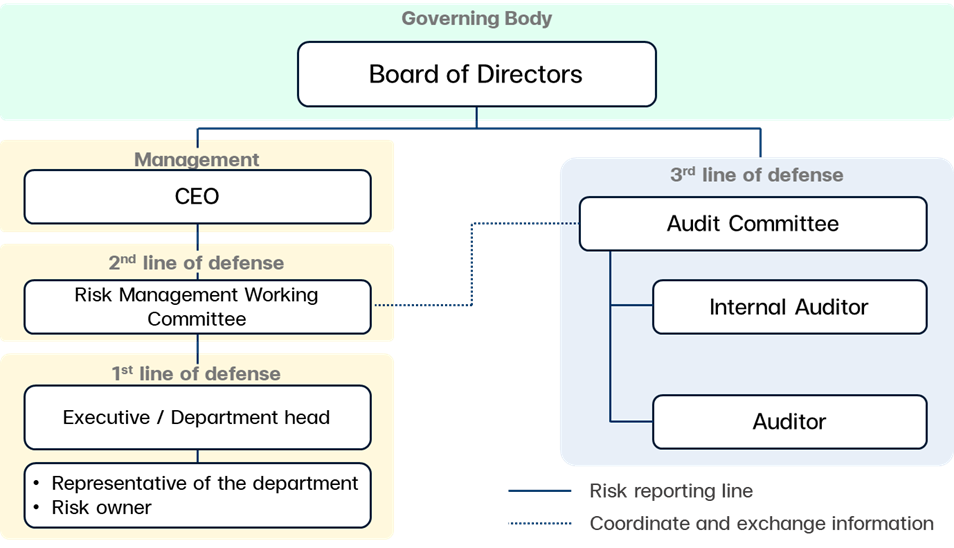
No. | Related Persons | Duties and Responsibilities |
1 | Board of Directors |
|
2 | Chief Executive Officer |
|
3 | Risk Management Working Committee |
|
4 | Executive / Department Head |
|
5 | Risk owner |
|
6 | Audit Committee |
|
7 | Internal Auditor |
|
The Risk Management Working Committee comprises executives from key business functions, including Strategy, Commercial, Technology, Operations, Finance & Accounting, People Management Development, and Compliance. The Chief Strategy Officer serves as the Chairperson of the Committee. In 2025, the Risk Management Working Committee convened to review key enterprise-wide risks, risk appetite, risk assessment criteria (Likelihood and Impact), risk prioritization using the Risk Matrix, and risk mitigation plans. The findings and recommendations were subsequently presented to the Chief Executive Officer and the Board of Directors.
Risk Management Process and Tools
Risk Level Classification
To enhance efficiency, ensure comprehensive coverage, and align with the company’s risk management framework, risks are classified into three levels as follows
No. | Risk level | Person in charge | Director |
1 | Enterprise Risk refers to risks that may significantly impact the achievement of the Group’s strategic objectives, sustainability goals, financial stability, and overall corporate reputation. These risks are considered highly significant and require oversight by the Board of directors and senior executives. | Board of Directors / C-level Executives | Board of Directors / Risk Management Working Committee |
2 | Functional risk refers to risks occurring at the department or functional level, which may affect the achievement of the respective department’s objectives and may also be linked to or impact enterprise risks. The department is primarily responsible for managing such risks. | Managers / Department Heads | Business Line Executives |
3 | Operational Risk refers to risks arising from day-to-day operations or activities. These risks may develop into the root cause of risks at both the functional and enterprise levels If not properly controlled. | Supervisors / Process Owners | Line Managers / Department Heads |
In the risk management process (comprising risk identification, risk assessment, and risk mitigation), each level is carried out according to the defined roles and responsibilities. This ensures that risks are properly controlled and that significant risks are escalated for consideration at higher management levels in accordance with the organization’s established criteria.
Risk Identification
Risk identification involves recognizing risks and uncertainties, both external and internal, that may impact the ability of the Group, business units, or departments to achieve their objectives. Risks are categorized into 5 key areas as follows:
Financial and Investment Risk
Strategic and Market Risk
Operational Risk
Environment and Social Risk
Legal and Compliance Risk
Risk Assessment
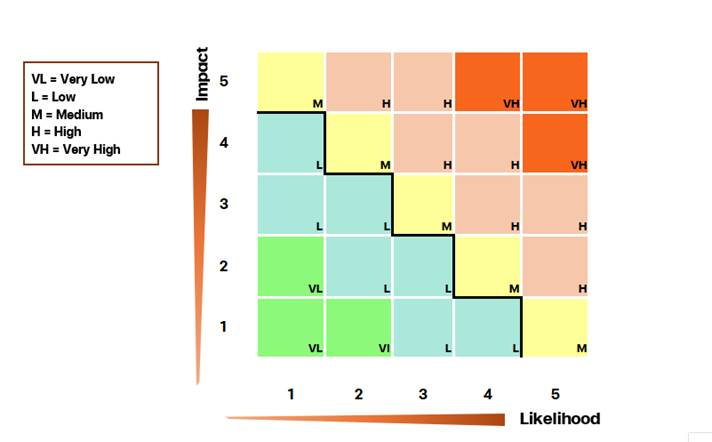
The Group establishes its Risk Appetite, which represents the level of risk the organization is willing to accept in pursuing its objectives. Risks are assessed using a Risk Map in the form of a 5x5 Risk Matrix, which evaluates risks based on two key criteria: the likelihood of occurrence and the severity of impact. The likelihood is classified into five levels, and the severity of impact considers various dimensions, including financial impact, production impact, operational processes, environmental and social impact, legal implications, and corporate reputation. Each impact category is further classified into five levels of significance: very high risk, high risk, moderate risk, low risk, and very low risk.
Risk Mitigation Plan
Risk management action plans are developed to control risks within acceptable levels (“Risk Tolerance”).
Risk Monitoring and Reporting
The monitoring process is planned to conduct by establishing Key Risk Indicators (“KRIs”) for each identified risk. The risk owners are responsible for reporting their KRI results. If any irregularities are detected, immediate mitigation actions must be taken. In cases where mitigation is not feasible, the issue must be escalated to management or the appropriate working committee as per the organizational structure.
Policy Document Link
https://www.chememan.com/storage/document/cg/risk-management-policy-en.pdf
Page Number in Report
1
Risks to the Company's Business Operations
Introduction
In 2025, Chememan identified and assessed key risks for the Group and established a risk mitigation plan as follows:
Risk Register
| Risk Name | Risk Characteristics | Consequences | Management Measures | Related Risk Factors |
|---|---|---|---|---|
| Foreign exchange risk | The Group has foreign currency exposure in US Dollars, Australian Dollars, and Vietnamese Dong due to the following factors:
| Fluctuation in Earnings After Tax |
| 764 · Description: Fluctuation in exchange rates, interest rates, or the inflation rate · Info category: FINANCIAL_RISK |
| Large-scale Investment Risk | The Group has operations in Australia, Vietnam, and India. If these subsidiaries and joint ventures cannot deliver their expected business performance, the Group’s performance and ability to meet its payment obligations could be at risk. | Fluctuation in Earning After Tax |
| 765 · Description: Fluctuation in return on assets or investment · Info category: FINANCIAL_RISK |
| Mining License Revocation | The Group has received mining licenses to operate limestone mining businesses in Saraburi, Thailand and Hoanh Bo, Vietnam. There is a risk that the licenses may be revoked if the company does not comply with the required conditions. In addition, issues in renewing the license may disrupt operations and affect the supply of resources. | Detrimental effect on the business, halt stock trading on the stock exchange, or result in the suspension of the business license |
| 760 · Other name: Mining License Revocation · Description: Other · Info category: COMPLIANCE_RISK |
| Changes in Demand and Supply Structure & Contract Management | Rapid shifts in the economy, regulations, consumer demand, or production conditions may lead to structural changes in supply and demand, which could negatively impact the lime market, the Group’s competitiveness, and its corporate strategies. Moreover, these changes may also affect the supply chain. As a result, the Group may experience fluctuations in sales volume, which could impact on revenue, costs, and inventory management. | Fluctuation in Gross Profits |
| 737 · Other name: Strategic and market Risk · Description: Other · Info category: STRATEGIC_RISK |
| Shipping Transportation Risk and Volatility of Ocean Freight Rates | The Group exports more than 60% of its products by sea, mainly using containers. Therefore, it has risks of delivery delays and fluctuations in ocean freight rates due to global conditions. | Fluctuation on Earning after tax |
| 737 · Other name: Strategic and market Risk · Description: Other · Info category: STRATEGIC_RISK |
| Key Positions for Business Expansion Risk | The Group is expanding rapidly, while global networking and connectivity have led to increased mobility of high-quality talent. As a result, the Group may face risks in recruiting or retaining high-potential personnel for key positions to support its expansion. Furthermore, there is a risk of failing to develop employees' capabilities sufficiently to cope with the fast-paced changes in the business environment. | Profitability Ratios, Fluctuation in Earnings After Tax |
| 737 · Other name: Strategic and Market Risk · Description: Other · Info category: STRATEGIC_RISK |
| Transition to a Low-Carbon Economy | Climate change may lead to increased operational costs, primarily due to carbon taxes. These costs could include energy expenses, electricity costs, and management fees related to future climate change regulations. The Group must find ways to minimize greenhouse gas emissions. Additionally, management practices and regulations will need to change to minimize the impact of greenhouse gas emissions. | Fluctuation in Earnings After Tax |
| 737 · Other name: Strategic and Market Risk · Description: Other · Info category: STRATEGIC_RISK |
| Fuel Procurement and Price Fluctuations | Since the Group uses coal and natural gas as fuel for lime production, it faces risks related to fuel supply and price fluctuations, particularly with coal prices and the fluctuations in natural gas prices. | Fluctuation in Cost of Manufacturing |
| 740 · Description: Shortage or fluctuation in pricing of raw materials or productive resources · Info category: OPERATIONAL_RISK |
| Production Interruptions Due to Emergencies | The Group primarily uses coal as its main fuel, which is highly flammable. This poses a risk of unexpected fires or explosions, potentially leading to production interruptions and impacting the safety of employees and assets. | Increasing production cost, Production interruptions |
| 755 · Other name: Operational Risk · Description: Other · Info category: OPERATIONAL_RISK |
| Business Continuity Management Risk | In practice, the Group has established emergency response and business continuity procedures. However, since these procedures have not yet been consolidated into a single, comprehensive business continuity plan, it may result in an insufficient response to emergencies. | Operational uncertainty impacting core business activity |
| 755 · Other name: Operational Risk · Description: Other · Info category: OPERATIONAL_RISK |
| Risks Relating to Occupational Health and Safety | The Group’s operations may impact on the work environment, occupational health, and employee safety, such as dust within factory areas, chemical exposure, noise, and confined spaces. Additionally, the Group may be at risk of suspension or termination of operation, it fails to comply with government regulations and relevant industry standards. | Employees’ health and safety, Employee injury rates |
| 749 · Description: Safety, occupational health, and working environment · Info category: OPERATIONAL_RISK |
| Cyber Security Risk | The adoption of digital technology may expose the group to cybersecurity risks, potentially leading to damage to assets, breaches of organizational or personal data, or system disruptions. | Information Technology System uncertainty, disruptions in core business operations |
| 744 · Description: Information security and cyber-attack · Info category: OPERATIONAL_RISK |
| Risks Related to Environmental Impact and Surrounding Communities | The Group's business operations may impact the environment and surrounding communities. Additionally, the Group may face suspension or revocation of its operating licenses, if it fails to comply with government regulations and relevant industry standards. | Company’s reputation, Risk of investigation and allegations of wrongdoing by government authorities |
| 1717 · Description: ESG risk · Info category: STRATEGIC_RISK |
| Contract Management Risk | The Group has entered into contracts with customers, suppliers, and business partners, which may involve risks arising from ineffective contract drafting, execution, and management. These risks could potentially lead to legal issues, financial losses, or damage to business relationships. | Damages from contracts |
| 760 · Other name: Legal and Compliance Risk · Description: Other · Info category: COMPLIANCE_RISK |
| Risk on Personal Data Protection | As the Group expands business both domestically and internationally, its operations involve more stakeholders, causing risk in processing personal data. The Group is aware of the importance of the protection of personal data and respects the privacy rights of those associated with or transacting with the Group. | Company’s reputation |
| 760 · Other name: Risk on Personal Data Protection · Description: Other · Info category: COMPLIANCE_RISK |
Risks to Securities Holders' Investment
Risk Register
| Risk Name | Risk Characteristics | Consequences | Management Measures | Related Risk Factors |
|---|---|---|---|---|
| Risk of the company having a majority shareholder holding > 25% of shares | Influence of major shareholders may create potential conflicts of interest with minority shareholders | Ineffective corporate governance may reduce minority shareholders’ confidence in the company’s securities |
| 2970 · Description: Risk of the company having a majority shareholder holding > 25% of shares · Info category: HOLDER_RISK |
| Risk of Dividend under Loan Agreements | The Group's loan agreements contain provisions stating that dividend payments cannot be made in the event of a breach of the loan terms, and its Australian subsidiary company cannot pay dividends exceeding 50% of net profit after tax. | If the Group fails to meet the terms of its loan agreements, it may be unable to pay dividends to shareholders as expected. | The Group closely manages and monitors its financial status to ensure compliance with loan terms, as well as planning cash flow and financial structure appropriately to avoid impacting long-term dividend payments. | 2971 · Description: Risk from loan contract terms that restrict dividend payment · Info category: HOLDER_RISK |