

Sustainability · 2025
In this section56 topics
- Sustainability Policy3 items
- Sustainability Goals & UN SDGs3 items
- Policy Review2 items
- Business Value Chain2 items
- Stakeholder Analysis2 items
- Environmental Sustainability — Overview2 items
- Environmental Policy & Guidelines5 items
- Environmental Policy Review1 item
- Energy Management — Overview1 item
- Energy — Plan & Guidelines2 items
- Energy — Electricity Consumption1 item
- Energy — Fuel Consumption2 items
- Energy — Targets3 items
- Energy — Performance & Outcomes2 items
- Water Management — Overview1 item
- Water — Plan & Guidelines3 items
- Water — Withdrawal, Discharge & Consumption5 items
- Water — Targets3 items
- Water — Performance & Outcomes2 items
- Waste Management — Overview1 item
- Waste — Plan & Guidelines3 items
- Waste — Generation, Disposal & Recycling3 items
- Waste — Targets2 items
- Waste — Performance & Outcomes3 items
- Greenhouse Gas — Overview1 item
- GHG — Plan & Guidelines2 items
- GHG — Emissions1 item
- GHG — Emissions Verification3 items
- GHG — Principles & Standards1 item
- GHG — Targets1 item
- GHG — Performance & Outcomes2 items
- Environmental Legal Incidents1 item
- Other Environmental Management1 item
- Social Sustainability — Overview1 item
- Social Policy & Guidelines4 items
- Social Policy Review1 item
- Human Rights Due Diligence2 items
- Employee Management — Overview1 item
- Employees — Plan & Guidelines4 items
- Employees — Workforce4 items
- Employees — Remuneration & Provident Fund2 items
- Employees — Training & Development2 items
- Employees — Occupational Health & Safety2 items
- Employees — Labour Relations3 items
- Employees — Employee Representation3 items
- Employees — Targets3 items
- Employees — Performance & Outcomes3 items
- Customers — Plan & Guidelines3 items
- Customers — Satisfaction Results2 items
- Customers — Targets1 item
- Customers — Performance & Outcomes2 items
- Community & Social — Plan & Guidelines4 items
- Community & Social — Targets3 items
- Community & Social — Performance & Outcomes3 items
- Other Social Management3 items
- Law Violation Incidents2 items
Sustainability Policy
Has a Sustainability Policy
Yes
Policy Description
Sustainability Management
The Company focuses on business sustainability in various ways, including strong corporate governance, inclusion of social and environmental issues into all major decisions, and professional communications with all stakeholders. The Company published the full version of its Sustainability Development Policy, including guidelines and goals on the Company’s website www.chememan.com.
Sustainability Development Goals (SDGs)
The Company has adopted the United Nations Sustainable Development Goals (“SDGs”) as a guideline for its Sustainability Development Policy and will play a proactive role to ensure its business contributes to achieving the targets set out by the SDGs.
Sustainability Development Framework
This Sustainability Development Policy sets out key principles and guidelines for all stakeholders across the business value chain. The Company is committed to optimizing the use of natural resources through technology and innovation, ensuring long-term environmental sustainability. To sustain its long-term business, the Company follows an integrated approach to achieve sustainability in all aspects of its operations, including management of the economic, environmental and social risks and opportunities as follows:
Economy and Governance
The Company operates its business by developing sustainable and integrated product solutions for customers to protect the environment while strengthening good corporate governance, complying with all laws and regulations, and committing to transparency, avoidance of corruption, and fair and ethical behavior. The Company’s governance is governed under its Risk Management Policy, Anti-Corruption Policy and Corporate Governance Policy. Full versions of these policies are available on the Company’s website at www.chememan.com.
Environment
The Company adopts technologies and proactive strategies to minimize negative impacts on the environment while finding ways to improve its business practices towards major environmental issues. Recognizable environmental stewardship activities include, but are not limited to resource management, energy management, climate change and carbon emission reduction, waste management, and many other sustainable actions. The Company’s environmental management direction is governed by its Environmental Policy. Full versions of these policies are available on the Company’s website at www.chememan.com.
Society
The Company encourages dialogue and participation with internal and external stakeholders by establishing clear communication channels and providing reliable and accurate disclosures of information. The Company is committed to uphold the laws and regulations of human rights and labor rights and provide a safe and healthy work environment that supports personal development, well-being, respect, non-discrimination, and equality. The Company’s social actions are governed under Social Management Policy and Human Rights Policy. Full versions of these policies are available on the Company’s website at www.chememan.com.
The Company has established a Sustainability Development Department to supervise and monitor the implementation of the Company’s Sustainability Development Policy in order to ensure its effectiveness and results. The Sustainability Development Policy covers all significant corporate, social and environmental issues.
Roles and Responsibilities of Sustainability Development Department
The Sustainable Development Department determines the direction and implements the Company’s sustainability strategy to align with its goals and Environmental, Social, and Governance (ESG) practices. Its responsibilities include:
Establish the Company’s sustainability goals and strategies
Develop sustainability action plans that align with corporate strategies and comply with environmental, social, and governance (“ESG”) requirements
Support and advise departments in implementing initiatives that promote efficient use of resources, reduce environmental impact, and create sustainable benefits for communities and society.
Coordinate with internal departments to ensure the implementation of sustainability initiatives in accordance with the established plan
Engage with external organizations to explore best practices and enhance the Company’s sustainability standards
Support sustainability communication and awareness both within and outside the organization
Oversee the implementation of sustainability projects to ensure alignment with the plan and report on project progress
Promote employee engagement in sustainability initiatives at all levels and conduct training programs to enable employees to integrate sustainability principles into their work
Policy Document Link
https://www.chememan.com/storage/document/cg/sd-policy-en.pdf
Sustainability Goals & UN SDGs
Has Sustainability Goals
Yes
Goals Description
The Company adopts an integrated approach to sustainability across all aspects of its operations, including the management of risks and opportunities related to economic, corporate governance, environmental, and social dimensions.
The Company has established the following targets:
Net Zero emissions by 2065
20 MW of electricity generation
100% wastewater reuse by 2050(all operations)
Zero landfill waste by 2050(all production sites)
Plant 20,000 carbon-credit trees by 2030
Reduce CO2 emissions by 30,000 tons per year through product design by 2050
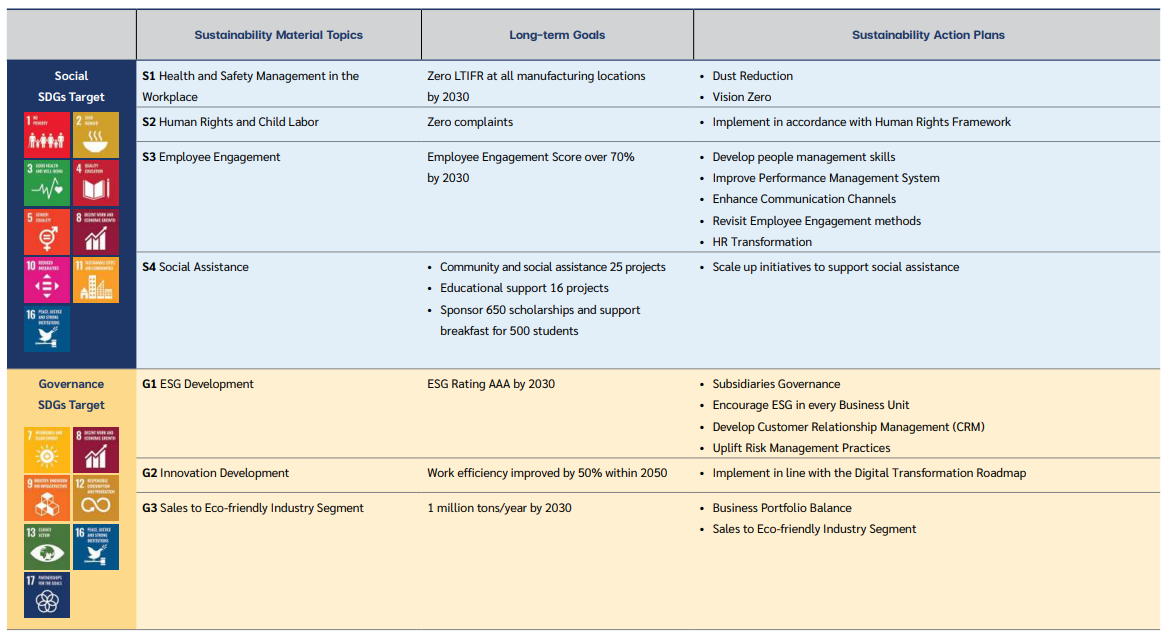
Achieve Lost Time Injury Frequency Rate (LTIFR) of zero (across all operations)
Zero complaints
Employee engagement score above 70% by 2030
25 community projects, 16 education projects, 650 scholarships, and breakfast support for 500 students
FTSE Russell score above 4.0 by 2026
50% improvement in operational efficiency through technology by 2050
Sell products to industries that reduce environmental impact, reaching 1 million tons per year by 2030.
UN Sustainable Development Goals
| SDG Goal |
|---|
| Goal 1 No Poverty |
| Goal 2 Zero Hunger |
| Goal 3 Good Health and Well-being |
| Goal 4 Quality Education |
| Goal 5 Gender Equality |
| Goal 6 Clean Water and Sanitation |
| Goal 7 Affordable and Clean Energy |
| Goal 8 Decent Work and Economic Growth |
| Goal 9 Industry, Innovation and Infrastructure |
| Goal 10 Reduce Inequalities |
| Goal 11 Sustainable Cities and Communities |
| Goal 12 Responsible Consumption and Production |
| Goal 13 Climate Action |
| Goal 15 Life on Land |
| Goal 16 Peace, Justice and Strong Institutions |
| Goal 17 Partnerships for the Goals |
Policy Review
Policy Reviewed This Year
No
Policy Changed This Year
No
Business Value Chain
Introduction
Chememan Public Company Limited conducts its business within a sustainable development framework by integrating the principles of Good Governance, Environmental Management, and Social Responsibility into its operations to manage risks, mitigate potential impacts, and create long-term value for all stakeholders.
To translate this commitment into tangible outcomes, the Company sets clear expectations for its business partners to strictly comply with all relevant laws and regulations, including standards on occupational health, safety, and the environment. The Company also promotes transparent and ethical business conduct, supported by appropriate risk management systems, with the aim of elevating responsibility standards throughout the supply chain.
The Company recognizes that creating sustainable value requires attentiveness to stakeholders across the entire value chain from upstream to downstream. It therefore strives to balance business growth, environmental stewardship, and social development. This approach has been integrated into all activities across the Company's business value chain.
Value Chain Description
Main Activities
Raw Material Sourcing
The Company manages its primary raw material which is chemical limestone through its own mining operations in Thailand and Vietnam. Efficient mining processes, overseen by professional personnel, ensure consistent quality and cost advantages throughout production. To further reduce supply risk, lower greenhouse gas emissions, and strengthen competitiveness, the Company diversifies its fuel procurement across multiple reliable suppliers.
Production and Quality Control
Production of limestone, ground limestone, quicklime and hydrated lime is done with leading international equipment that results in highly consistent product quality and regular inspections throughout the entire process.
Storage and Packaging
Products in bags and silos are stored in storage facilities with efficient storage management systems and ready to be delivered to customers.
Logistics and Supply Chain
Products are delivered either by the Company’s own truck fleet or by third-party logistics providers to its customers. In support of carbon emissions reduction, the Company promotes the use of electric trucks. The Company sets strict logistics guidelines in compliance with government regulations across the entire supply chain; from receiving the products, to delivering at final destinations. Safety of stakeholders who may be affected by the transportation of products such as local communities, drivers, operators is taken into consideration. For overseas shipments, the Company commissions leading logistics providers to cover a wide range of countries to ensure the effectiveness and quality of each shipment.
Marketing and After-sales Service
In addition to producing quality products, the Company also collaborates with customers to offer sustainable solutions that fulfil their long-term needs as well as providing after-sales services from the commercial team. The Company also values and gathers customer opinions via the Customer Satisfaction Assessment Form to continuously improve the operational processes and systems.
Support Activities
Procurement
The Company has procurement procedures to meet its operational needs by purchasing and agreeing to terms and conditions for goods and services from several trusted partners with competitive prices and strict compliance with the agreed terms. Furthermore, collaboration is emphasized through active engagement with partners including listening and exchanging opinions, in order to sustainably meet the needs of both parties, as well as to jointly develop and improve working processes.
In addition, the Company promotes sustainable procurement by encouraging partners and business allies to recognize the importance of conducting business sustainably, encompassing environmental, social, and governance (ESG) dimensions.
Community Relations
The Company supports community activities to create public benefits, opportunities and seeks ways to continuously increase income for surrounding communities, as well as conduct business activities by integrating community and social dimensions into the preparation of action plans to prevent impact on communities and society.
Human Resources Development
The Company has recruitment and personnel development systems to equip employees with new skills and capabilities that are aligned with the Company’s growth plans. These systems cover occupational health, safety, well-being care, and compensation and benefits. The Company also focuses on fostering unity, which is integral to driving the Company towards its goals.
Technology Development
The Company adopts modern technologies and digitalization to improve processes in various dimensions. This progress is driven by collaboration with internal working teams and global business partners to develop innovations and solutions that align with the Company's long-term direction.
Stakeholder Analysis
Introduction
The Company values the contribution and involvement of all internal and external stakeholders, especially any recommendations to sustainability practices. The Company separates stakeholders into 7 categories, where each category has varying channels of appropriate communications and contributions.
Stakeholder Analysis
| Stakeholder Type | Stakeholders | Stakeholder Expectations | Response to Expectations | Communication Activities |
|---|---|---|---|---|
| Internal stakeholders | 2913 · Description: Shareholders | • Return on Investment
• Transparency and Accuracy of Information | • Collaborate with relevant agencies to enhance operational efficiency and product development.
• Provide opportunities for shareholders to directly submit comments and complaints to the company.
• Expand investment projects both domestically and internationally to increase profitability.
• Establish various policies to prevent conflicts of interest and provide transparent information in accordance with national standards. | 2938 · Description: Visit · 2941 · Description: Online Communication · 2944 · Description: Annual General Meeting (AGM) · 2945 · Description: Complaint Reception · 2949 · Other name: Annual Information Form / Annual Report · Description: Others · 2949 · Other name: Direct contact with the company · Description: Others · 2949 · Other name: Communication and information disclosure to investors through investor engagement activities (e.g., Opportunity Day and Roadshow) · Description: Others |
| External stakeholders | 2923 · Description: Customers | • Satisfaction with products and services
• Receipt of quality products and services within the specified time
• Efficient problem-solving time
• Prompt response to needs | • Ensure consistent product quality
• Maintain high and timely delivery standards
• Provide professional advice on product usage and problem-solving | 2938 · Description: Visit · 2945 · Description: Complaint Reception · 2947 · Description: Satisfaction Survey · 2949 · Other name: Customer Engagement · Description: Others · 2949 · Other name: Online and telephone communication · Description: Others · 2949 · Other name: Organizing activities to build relationships with stakeholders · Description: Others |
| External stakeholders | 2899 · Description: Suppliers | • Goods and services received from partners as per agreed conditions
• Competitive prices for goods and services
• Maintenance of favorable relationships between sellers and buyers | • Strictly comply with mutually agreed-upon conditions.
• Listening to and exchanging opinions with partners to sustainably address the needs of both parties, as well as developing and improving collaborative work processes. | 2945 · Description: Complaint Reception · 2949 · Other name: Customer Engagement · Description: Others · 2949 · Other name: Communication via online channels and telephone · Description: Others · 2949 · Other name: Organizing activities to build relationships with stakeholders · Description: Others |
| Internal stakeholders | 2921 · Description: Employees | • Job security and career advancement
• Appropriate welfare and compensation
• Opportunities for learning and skill development
• Good care in occupational health, safety, and quality of life | • Continuously develop employee potential
• Ensure safety and occupational health
• Determine appropriate compensation and benefits for employees | 2945 · Description: Complaint Reception · 2949 · Other name: Internal Public Relations Media · Description: Others · 2949 · Other name: Online Communication System (Line/Website/E-mail) · Description: Others · 2949 · Other name: Feedback and Suggestion Box · Description: Others · 2949 · Other name: Internal activities organized by the company · Description: Others |
| External stakeholders | 2902 · Description: Community · 2928 · Description: Society | • Maintain the community environment by not emitting pollutants
• Support community activities
• Contribute to public benefits and help increase community income
• No complaints from the community | • Operate the business with due diligence and caution to prevent adverse impacts on communities, society, and the environment.
• Strictly adhere to all applicable laws. | 2945 · Description: Complaint Reception · 2947 · Description: Satisfaction Survey · 2949 · Other name: Community Engagement Activities · Description: Others · 2949 · Other name: Consultation with community leaders · Description: Others · 2949 · Other name: Community engagement activities · Description: Others · 2949 · Other name: Online Communication Channels (Line/Facebook/Website) · Description: Others |
| External stakeholders | 2933 · Description: Non-profit organization / NGOs · 2936 · Other name: Local Administrative Organization · Description: Others | Reduce impacts from pollution | Strictly comply with relevant laws | 2945 · Description: Complaint Reception · 2949 · Other name: Meeting and Discussion · Description: Others · 2949 · Other name: Support for local activities · Description: Others · 2949 · Other name: Environmental Impact Assessment (EIA) · Description: Others |
| External stakeholders | 2936 · Other name: Government agency · Description: Others | • Compliance with laws and regulations;
• Reducing potential impacts on communities and the environment | • Strictly comply with applicable laws.
• Establish and assign a responsible unit for appropriate coordination with government agencies. | 2949 · Other name: Meeting and Discussion · Description: Others · 2949 · Other name: Reporting of results to government agencies · Description: Others · 2949 · Other name: Support for Government Activities · Description: Others |
| External stakeholders | 2929 · Description: Media | Disclose clear, accurate, relevant, and timely information. | Communicate and disclose comprehensive operational information of the company. | 2945 · Description: Complaint Reception · 2949 · Other name: Meeting and Discussion · Description: Others · 2949 · Other name: Communication via online channels and telephone · Description: Others · 2949 · Other name: Online Communication Channels (Line/Facebook/Website) · Description: Others |
| External stakeholders | 2894 · Description: Creditor | Build confidence for creditors that they will receive full and timely debt repayment. | Adhere to the terms and conditions stipulated in the loan agreement, security agreement, and/or related agreements, and comply with all applicable laws concerning debt repayment. | 2949 · Other name: Quarterly Operating Results Statement · Description: Others · 2949 · Other name: Meeting and Discussion · Description: Others · 2949 · Other name: Communication via online channels and telephone · Description: Others |
Environmental Sustainability — Overview
Introduction
The company recognizes that environmental management is an important part of sustainable development. Environmental considerations are integrated into the company’s business strategy, corporate governance, and decision-making processes to balance economic growth, social responsibility, and the protection of natural resources.
The company has set environmental policies, goals, and practices that focus on resource optimization, pollution prevention, waste and water management, and reducing greenhouse gas emissions. The company also complies with relevant laws and standards and regularly monitors and reports its environmental performance.
We have established targets and operational plans aligned with our strategy, encompassing ESG dimensions and key stakeholders across the entire value chain as follows:.
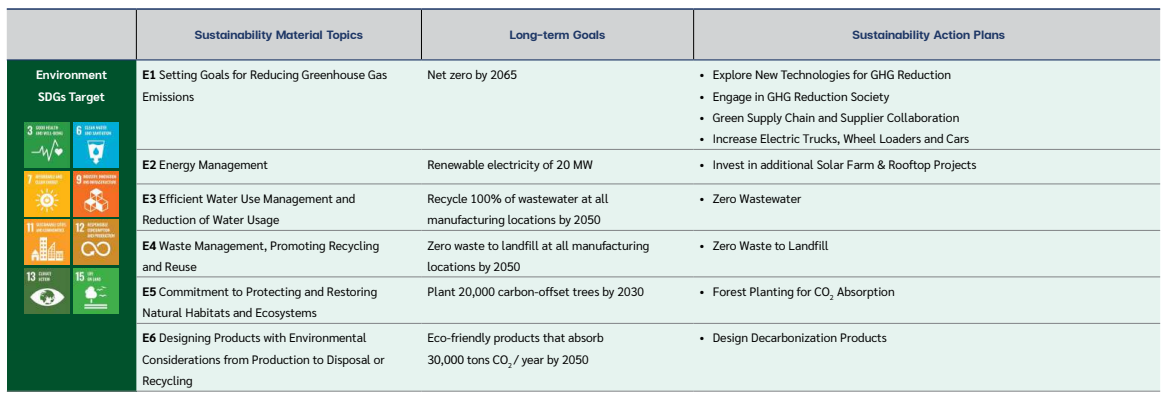
Environmental Sustainability Management
The company conducts its business with responsibility toward the environment and society. It values environmental protection and focuses on using energy and resources efficiently so that business growth and environmental care can progress together. The company considers the environment an important part of its operations.
Implementation of Environmental Measures
The company strictly follows all relevant environmental laws and standards set by regulatory authorities. This includes measures to prevent environmental impacts and systems to monitor environmental performance. The results of environmental quality monitoring in all areas remain within the standards required by law.
Investment
The Company integrates environmental aspects into the process of investment decision making.
Pollution Prevention and Resource Consumption Optimization
The Company carefully manages consumption of energy, utilities (e.g., electricity, coal, and water) and resources and finds ways to reduce, reuse and recycle as many inputs as possible.
Communication and Public Relation
The Company regularly encourages employees and stakeholders to be aware of their responsibilities towards the environment, society, and nearby communities.
The Company has an Environmental Committee at each production facility to consider and develop environmental policies and plans, suggest measures or guidelines to be in line with updated environmental legislation, and maintain the environmental management system based on ISO 14001: 2015, ensuring effective environmental management in alignment with company policies and regulatory requirements, and to support the organization’s progress toward sustainability.
Operating Results — Introduction
The company places importance on environmental management in its production processes. It complies with relevant laws and standards while working to reduce environmental impacts from factory operations.
During the past year, the company implemented measures such as air and water pollution control, industrial waste management, efficient use of resources and energy, and regular environmental monitoring.
These efforts show progress in improving production efficiency and reducing environmental impact, supporting the company’s long-term sustainable development.
Environmental Policy & Guidelines
Introduction
The company is committed to conducting its business with environmental responsibility. It has established environmental policies and practices to prevent and reduce environmental impacts across its value chain while complying with relevant laws and standards.
The policies focus on optimizing resources, pollution control, waste and water management, and reducing greenhouse gas emissions. The company also encourages employees and stakeholders to take part in environmental protection.
The policies are communicated to employees and regularly reviewed to ensure effective implementation and support long-term sustainable operations.
Has an Environmental Policy
Yes
Policy Description
The company has established environmental policies and practices to protect the environment, prevent pollution, and maintain a healthy environment as follows:
Operate and continuously improve the environmental management system in compliance with relevant laws and regulations.
Set environmental objectives and targets, including the control of air, noise, dust, and water pollution, with regular monitoring, evaluation, and review for continuous improvement.
Use resources such as water, electricity, fuel, and other materials efficiently to maximize benefits. The company also promotes the reuse of materials and controls wastewater and dust from production and transportation to minimize environmental impact.
Reduce waste, including solid waste and industrial waste, by applying the 3Rs principle (Reduce, Reuse, Recycle) with the goal of achieving Zero Waste to Landfill.
Provide support in terms of personnel, time, budget, and training for employees, stakeholders, and communities to build environmental awareness and ensure compliance with environmental standards across the organization.
The company will continue to operate and improve its environmental management system to ensure effectiveness and ongoing development.
Policy Document Link
https://www.chememan.com/storage/document/cg/environmental-policy-en.pdf
Environmental Guidelines
| Guideline |
|---|
| Electricity Management |
| Fuel Management |
| Renewable/Clean Energy Management |
| Water Management |
| Waste Management |
| Greenhouse Gas and Climate Change Management |
| Air Quality Management |
Environmental Policy Review
Policy Reviewed This Year
No
Energy Management — Overview
Introduction
The company prioritizes energy management alongside environmental protection and the appropriate use of technology to support sustainable growth. A Technology and Operation Towards Environmental, Social, and Governance Committee, composed of senior executives, oversees and monitors energy management initiatives.
The committee analyzes data to improve energy efficiency, promote renewable energy use, and reduce waste from operations. It also develops policies and plans aligned with the company’s strategy and regularly meets with management to review progress and assess risks related to energy, environment, and technology.
Energy — Plan & Guidelines
Has an Energy Management Plan
Yes
Plan Description
The company develops its operational plans in line with its Carbon Reduction Roadmap, focusing on energy used in combustion and key machinery, including thermal energy and electricity. Technology selection is based on detailed studies, economic feasibility, and suitability for the company’s operations. Key initiatives include solar power generation, the transition of trucks to electric vehicles to reduce fuel use, and the use of biomass fuel as a substitute for coal.
In addition, the company continues to improve existing production processes and maintains equipment regularly to ensure high production efficiency and optimal energy use.
Carbon reduction over 200,000 tCO2eq by 2030
Installed solar power systems for daytime electricity use at Kang Koi Plant, Prabuddhabaht Plant, and other facilities. By 2025, a total capacity of over 8.7 MW had been installed.
Replaced fossil fuel vehicles (such as trucks, production vehicles, and buses) with electric vehicles, including wheel loaders and forklifts.
Conducted pilot testing of biomass fuel as an alternative energy source.
From these initiatives, Chememan is expected to reduce greenhouse gas emissions by approximately 200,000 tCO2eq.
Net zero by 2050
Replace coal fuel with biomass or other clean energy sources for combustion in lime kilns.
Transition all trucks from fossil fuels to electric vehicles or other clean energy alternatives.
Install renewable energy systems to replace 100% of electricity generated from fossil fuels.
Study the adoption of net-zero lime kiln technology in the production process.
Explore carbon capture, utilization, and storage (CCUS) and carbon utilization (CCU) by capturing CO2 from production processes for storage or converting it into other materials, in collaboration with the Saraburi Sandbox project.
Energy — Electricity Consumption
Electricity Consumption
| Metric | Current Year | Previous Year | Two Years Ago | Remark |
|---|---|---|---|---|
| Total electricity consumption within the organization (Kilowatt-Hours) | 47,055,693 | 54,157,926 | 49,486,426 | Includes electricity purchased from the Provincial Electricity Authority (PEA) and electricity generated from solar farms. |
| Electricity purchased for consumption from non-renewable energy sources (Kilowatt-Hours) | 39,109,073 | 44,702,810 | 44,943,550 | Electricity purchased from PEA. |
| Electricity purchased or generated for consumption from renewable energy sources (Kilowatt-Hours) | 7,946,620 | 9,455,116 | 4,542,876 | Electricity generated from solar farms with installed capacity as follows: Kang Koi branch 7.0 MW, Thap Kwang branch 158 kW, Prabuddhabaht branch 1.5 MW, and Rayong branch 104 kW. |
Energy — Fuel Consumption
Introduction
Most fuel used by the company is for transportation and production processes. The Kang Koi plant mainly uses coal to burn chemical limestone, while the Prabuddhabaht plant uses both coal and natural gas.
At the Thap Kwang quarry, operations focus on limestone mining, sorting, and crushing to supply raw materials to the plants. The main fuels used are diesel and gasoline. The Rayong plant receives lime from the Kang Koi and Prabuddhabaht plants to produce hydrated lime, where diesel is the main fuel used in the process.
Fuel Consumption
| Metric | Current Year | Previous Year | Two Years Ago | Remark |
|---|---|---|---|---|
| Crude oil (Barrels) | ||||
| Coal (Metric tonnes) | 68,643 | 78,244 | 75,309 | Data for 2025 covers the period up to November |
| Jet fuel (Litres) | ||||
| Diesel (Litres) | 1,944,118 | 2,602,591 | 2,861,147 | Data for 2025 covers the period up to November |
| Gasoline (Litres) | 179.33 | 249.41 | 155.49 | Data for 2025 covers the period up to November |
| Fuel oil (Litres) | ||||
| Natural gas (Standard cubic feet) | 369,392,875.44 | 517,273,565 | 561,693,036 | Data for 2025 covers the period up to August |
| LPG (Kilograms) | ||||
| Steam (Metric tonnes) |
Energy — Targets
Introduction
Electricity generation target: 20 Megawatts
Has Set Targets
Yes
Targets
| Target | Base Year | Target Year | Target Year Value | Target Change (%) | Unit | Per Unit (Intensity) | Per Unit — Please Specify |
|---|---|---|---|---|---|---|---|
| Increase of electricity consumption from renewable energy sources | 2,022 | 2,065 | 9,557 | 1.2 | Megawatt-Hours | Megawatt-hour of product | Megawatt-hour of product |
Energy — Performance & Outcomes
Has Performance Results
Yes
Performance Description
The company has ordered 17 electric trucks (EV Trucks). Five units were delivered in 2025, and the remaining 12 units are expected to be delivered in 2026. In addition, all forklifts have been fully replaced with electric forklifts (EV Forklifts). This investment helps reduce transportation costs for customers and supports the reduction of greenhouse gas emissions.
In addition, a 2 MW solar farm project at the Kang Koi plant has been completed and is expected to begin commercial operations in mid-2026. The project will increase the company’s use of clean electricity and reduce reliance on externally purchased power. This initiative aligns with the company’s sustainability policy to improve energy efficiency and support the transition to low-carbon energy.
Water Management — Overview
Introduction
Water is reused by collecting water generated from activities such as washing limestone before the production process and lime production operations, and reusing it within the plant.
Water — Plan & Guidelines
Introduction
The company provides areas for collecting and storing water generated from various processes so it can be reused within the plant.
Has a Water Management Plan
Yes
Plan Description
Study methods to reuse water and measure water consumption.
Water — Withdrawal, Discharge & Consumption
Withdrawal by Source — Introduction
The company uses several types of water. The Thap Kwang quarry, Kang Koi plant, and Prabuddhabaht plant use groundwater, while the Rayong plant uses a water supply.
This water is used for both general consumption and production processes.
Discharge by Destination — Introduction
The company has a policy not to discharge wastewater outside the factory premises, except at the Rayong plant, where wastewater is sent to the central wastewater treatment system of Amata City Rayong.
Consumption — Introduction
The types of water used by the company include groundwater (at the Thap Kwang quarry, Kang Koi plant, and Prabuddhabaht plant) and water supply (at the Rayong plant).
Recycling — Introduction
The Prabuddhabaht plant reuses water through activities such as spraying roads to reduce dust dispersion.
Water Withdrawal, Discharge & Consumption
| Metric | Current Year | Previous Year | Two Years Ago | Remark |
|---|---|---|---|---|
| Total water withdrawal (Cubic meters) | 79,183 | 80,401.5 | 106,210.1 | Total water consumption from Kang Koi plant, Prabuddhabaht plant, Rayong plant, and Thap Kwang quarry. |
| Total water withdrawal by third-party water (Cubic meters) | 38,486 | 38,077 | 40,090 | Water supply consumption at the Rayong plant. |
| Total water withdrawal by surface water (Cubic meters) | ||||
| Total water withdrawal by groundwater (Cubic meters) | 40,697 | 42,324.5 | 66,120.1 | Groundwater consumption at the Kang Koi plant, Prabuddhabaht plant, and Thap Kwang quarry. |
| Total water withdrawal by seawater (Cubic meters) | ||||
| Total water withdrawal by produced water (Cubic meters) | 0 | 0 | 0 | |
| Percentage of wastewater treated before discharge (%) | ||||
| Total water discharge (Cubic meters) | 7,697.2 | 7,615.4 | 8,018 | Currently, 100% of water at the Prabuddhabaht plant is reused (recycled). The company also has a policy not to discharge wastewater outside the factory area, except for the Rayong plant, where wastewater is sent to the central treatment system of Amata City Rayong. |
| Total water discharge to third-party water (Cubic meters) | ||||
| Total water discharge to surface water (Cubic meters) | ||||
| Total water discharge to groundwater (Cubic meters) | ||||
| Total water discharge to seawater (Cubic meters) | ||||
| Total water consumption (Cubic meters) | 71,485.8 | 72,786.1 | 98,192.1 | |
| Recycled water (Cubic meters) | 140,075 | In 2025, 100% of water at the Prabuddhabaht plant was reused (recycled). |
Water — Targets
Introduction
100% water reuse by 2050 across all plants
Has Set Targets
Yes
Targets
| Target | Base Year | Base Year Value | Target Year | Target Change (%) | Unit |
|---|---|---|---|---|---|
| Increase of recycled water for consumption | 2,024 | 0 | 2,050 | 100 | Cubic meters |
Water — Performance & Outcomes
Has Performance Results
Yes
Performance Description
In 2025, the company managed water by reusing (recycling) water at the Prabuddhabaht plant, totaling approximately 140,075 cubic meters. This water comes from activities such as washing limestone before the crushing process and lime production. The recycled water is reused within the plant, for example spraying roads to reduce dust dispersion.
Waste Management — Overview
Introduction
Waste management is an important environmental issue that requires attention from all sectors. The increasing amount of waste affects natural resources, ecosystems, and the quality of life. Therefore, proper waste management is essential to reduce these impacts and support sustainable development for both the organization and society.
Waste — Plan & Guidelines
Introduction
The company has developed a waste management plan to provide clear guidelines and measures for systematic waste management. The plan covers waste prevention and reduction, waste separation, storage, reuse, and proper disposal in accordance with relevant laws and standards. This plan helps reduce environmental impacts, improve resource efficiency, and support the company’s long-term sustainability goals.
Has a Waste Management Plan
Yes
Plan Description
In 2025, the company managed both hazardous and non-hazardous waste by studying appropriate treatment methods for each type and selecting approaches that minimize landfill disposal. The company also applies the 3Rs principle (Reduce, Reuse, Recycle) to help reduce waste generated within the organization.
Waste — Generation, Disposal & Recycling
Waste Generation — Introduction
The company prioritizes waste management in accordance with the guidelines of the Department of Industrial Works. Waste, both hazardous and non-hazardous, is systematically classified, monitored, and recorded. The company follows the 3Rs principle (Reduce, Reuse, Recycle) to reduce waste and minimize landfill disposal. Waste that cannot be reused is handled by licensed waste disposal contractors in compliance with legal requirements.
Recycling — Introduction
The company prioritizes waste management by promoting reuse and recycling in line with sustainable waste management principles. Waste is systematically sorted and monitored to identify materials that can be reused or recycled. This approach helps reduce waste sent for final disposal, lowers the use of new resources, and supports environmentally responsible operations.
Waste Generation, Disposal & Recycling
| Metric | Current Year | Remark |
|---|---|---|
| Total waste generated (Kilograms) | 457,458 | Total waste from all sites including Kang Koi plant, Prabuddhabaht plant, Rayong plant, and Thap Kwang quarry. |
| Non-hazardous waste (Kilograms) | 441,166 | Total non-hazardous waste from all sites. |
| Non-hazardous waste - Landfilling (Kilograms) | 0 | |
| Non-hazardous waste - Incineration (with energy recovery) (Kilograms) | 5,610 | |
| Non-hazardous waste - Incineration (without energy recovery) (Kilograms) | 0 | |
| Non-hazardous waste - Other disposal operations (Kilograms) | 435,556 | |
| Hazardous waste (Kilograms) | 16,292 | Total hazardous waste from all sites. |
| Hazardous waste - Landfilling (Kilograms) | 0 | |
| Hazardous waste - Incineration (with energy recovery) (Kilograms) | 14,119 | |
| Hazardous waste - Incineration (without energy recovery) (Kilograms) | 0 | |
| Hazardous waste - Other disposal operations (Kilograms) | 2,173 | |
| Total reused/recycled waste (Kilograms) | 402,267 | Total waste from all sites including Kang Koi plant, Prabuddhabaht plant, Rayong plant, and Thap Kwang quarry. |
| Reused/Recycled non-hazardous waste (Kilograms) | 1,890 | Non-hazardous waste from all sites, such as plastic bottles, bottle caps, and milk cartons. |
| Reused non-hazardous waste (Kilograms) | 0 | |
| Recycled non-hazardous waste (Kilograms) | 1,890 | Examples of recycled non-hazardous waste include clothing made from plastic bottles, cup coasters made from bottle caps, and roofing materials made from milk cartons. |
| Reused/Recycled hazardous waste (Kilograms) | 400,377 | |
| Reused hazardous waste (Kilograms) | 0 | |
| Recycled hazardous waste (Kilograms) | 400,377 |
Waste — Targets
Introduction
The company prioritizes waste management in accordance with the guidelines of the Department of Industrial Works. Waste, both hazardous and non-hazardous, is systematically classified, monitored, and recorded. The company follows the 3Rs principle (Reduce, Reuse, Recycle), with a focus on reuse and recycling to reduce waste and minimize landfill disposal.
Waste that cannot be reused or recycled is handled by licensed waste disposal contractors in compliance with legal requirements. This approach helps reduce the use of new resources and supports environmentally responsible operations.
The details of the waste management targets are as follows:
Target | Base Year | Target Year | Method |
Achieve Zero Waste to Landfill by 2050 | 2024: Operations in Thailand achieved 100% zero waste to landfill | 2050: Achieve zero waste to landfill across all production plants | Study waste treatment methods for each type of waste and select options that minimize landfill disposal |
Has Set Targets
No
Waste — Performance & Outcomes
Introduction
In 2025, the company successfully achieved 100% zero waste to landfill.
Has Performance Results
Yes
Performance Description
Amata Best Waste Management Awards 2025: The Rayong plant received the Platinum Continuous Award for effective waste management based on the 3Rs and circular economy principles.
“Waste for Eggs” Project: Employees collected 10,713 plastic bottles, 160 plastic food containers, and 3,960 plastic cups in exchange for eggs.
CMAN Zero Waste from Factory to School: Plastic bottles in exchange for eggs project. And the Plastic bottles from the project were upcycled into school bags for students.
Greenhouse Gas — Overview
Introduction
Climate change from greenhouse gas emissions is a key sustainability issue for the company. The company recognizes the risks from changing climate policies and regulations that may affect its operations, customers, communities, and stakeholders.
Therefore, the company has established a vision, mission, and policies to reduce greenhouse gas emissions from both direct and indirect sources related to its business activities.
GHG — Plan & Guidelines
Has a GHG Management Plan
Yes
Plan Description
The company aims to achieve Net Zero greenhouse gas emissions for Scope 1 and Scope 2 by 2065. To reach this goal, the company is implementing measures to transition to clean energy. These include the use of sustainable biomass fuel, green electricity generation and use, and electric vehicles (EVs).
The company is also developing products and innovations that can capture and store carbon dioxide effectively. In addition, it is studying and developing Carbon Capture, Utilization, and Storage (CCUS) technologies and other carbon sink solutions to reduce greenhouse gas emissions in the long term. The company collaborates with organizations and industry associations both domestically and internationally to support the transition toward carbon neutrality and Net Zero emissions.
The company also supports the reduction of Scope 3 greenhouse gas emissions by improving resource efficiency, using recycled materials, and developing energy-efficient technologies.
It also implements Green Procurement to encourage suppliers to adopt clean energy and reduce environmental impacts. Environmental, social, and governance performance is considered in supplier selection, and all suppliers must follow the company’s Supplier Code of Conduct. More details are available on the company’s website: www.chememan.com.
GHG — Emissions
GHG Emissions
| Metric | Current Year | Previous Year | Two Years Ago | Remark |
|---|---|---|---|---|
| Total GHG emissions (Metric tonnes of carbon dioxide equivalent) | 697,204 | 696,080 | 689,010 | Gas Emissions from Kang Koi, Prabuddhabaht, and Rayong Plants |
| Total greenhouse gas emissions 1 (Metric tonnes of carbon dioxide equivalent) | 625,631 | 617,073 | 621,173 | |
| Total greenhouse gas emissions 2 (Metric tonnes of carbon dioxide equivalent) | 19,557 | 19,694 | 19,885 | |
| Total greenhouse gas emissions 3 (Metric tonnes of carbon dioxide equivalent) | 52,016 | 59,313 | 47,952 |
GHG — Emissions Verification
Introduction
The company recognizes greenhouse gas management as an important environmental issue and part of its responsibility for sustainable business operations. The company has established management approaches and measures to reduce greenhouse gas emissions in line with relevant laws, standards, and practices.
During the past year, the company prepared a greenhouse gas emissions inventory covering both direct and indirect emissions from its activities. The emissions data were also verified by an independent third party to ensure accuracy and reliability.
This verification improves transparency in greenhouse gas disclosure and supports the evaluation of emission reduction measures, as well as the development of future targets and actions to support the transition to low-carbon business operations.
Emissions Verified by a Third Party
Yes
Verifying Body
2650
GHG — Principles & Standards
Principles & Standards Applied
| Standard |
|---|
| 2671 |
GHG — Targets
Has Set GHG Targets
No
GHG — Performance & Outcomes
Has Performance Results
Yes
Performance Description
Chememan has 5 key projects to support its goal of achieving Net Zero greenhouse gas emissions by 2050.
Solar Energy Investment installs solar panels to generate electricity for the Kang Koi factory in Saraburi province.
Electric Vehicle (EV) Project replaces delivery trucks with EVs at Kang Koi and other branches to improve logistics efficiency.
Biomass Fuel Project switches from coal to biomass fuel to reduce combustion emissions at the Kang Koi factory.
Paperless Project moves business documents, storage, approvals, and signatures to electronic systems to reduce paper use across the organization.
20,000 Trees Planting Project (by 2030) focuses on planting carbon-credit certified trees that also serve as community food sources, generating income and supporting local livelihoods.
In 2025, Chememan received the Green Industry Level 4 "Green Culture" award from the Department of Industrial Works, Ministry of Industry.
Environmental Legal Incidents
Legal Violation Incidents
| Metric | Current Year | Previous Year | Two Years Ago |
|---|---|---|---|
| Number of cases or incidents of legal violations or negative environmental impact (cases) | 0 | 0 | 0 |
Other Environmental Management
Plan Description
Ecosystem Protection and Biodiversity
Target: Plant 20,000 trees that generate carbon credits by 2030
Plan and Performance
In 2025, the company planted 3,500 trees. The selected species are mainly plants that can serve as food sources and help communities generate income, such as neem, trumpet tree, Indian gooseberry, mango, tamarind, java plum, bamboo, and agasta. These species are also recognized for carbon credit calculation.
In addition, the company collaborated with the Royal Forest Department to develop new firebreaks and maintain existing ones around the Ban Tham Nam Phu community forest. Firefighting equipment was also provided to prepare for emergencies. The company also built check dams using natural materials in the community forest to store rainwater and increase forest moisture.
Eco-Friendly Product Design
Target: Design products that help reduce 30,000 tons of CO2 emissions per year by 2050.
Plan and Performance
The company studies and develops environmentally friendly products, covering the entire lifecycle from production, disposal, to reuse. These products aim to reduce environmental impact while improving resource efficiency.
In 2024, the company successfully designed a product that requires less energy in the production process. This is an important step toward reducing carbon emissions and energy use, while also improving production efficiency and supporting sustainable cost reduction.
The company hires certified environmental monitoring agencies to regularly measure environmental quality. Results for air quality, noise, vibration, and other indicators are all within legal standards. Mining operations also follow the environmental requirements in the EIA and relevant regulations.
In production, the company uses dust control systems to reduce air pollution and protect workers and nearby communities. The company also promotes energy conservation among employees and implements the ISO 14001 Environmental Management System.
Additional initiatives include the “Waste Back Home” project, which converts waste into energy for communities, and the “Re No Waste from Factory to School” project, which upcycles used plastic bottles into school bags for students.
Employee Management — Overview
Introduction
In 2025, the Company continued to prioritize people as a key driver of sustainable business growth. Employees are supported in line with Thai labor laws and the Company’s human rights policies, while a culture of Diversity, Equity, Inclusion, and Belonging (DEI&B) is promoted to respect differences and ensure equal opportunities for all. The Company aims to provide a safe and supportive workplace where employees can develop their potential, grow in their careers, and contribute to a positive and sustainable organization.
To achieve the set objectives, the Company reviewed and updated its policies, processes, and related forms to ensure alignment with labor relations law and human rights principles, covering employment terms, working hours, rest periods, holidays, and recruitment. Clear hiring guidelines are also in place to prevent labor law violations, including child labor. Compensation is based purely on performance, regardless of gender, age, religion, or nationality, supported by a transparent and consistent performance management system. Employees are also free to choose additional training topics beyond mandatory courses, available both online and in person.
To keep communication open, employees can share feedback through engagement surveys, activity feedback forms, and suggestion boxes. Quarterly Welfare Committee meetings further provide dedicated space for employees to discuss and negotiate their benefits directly with management.
In 2025, approximately 26% of the Company's workforce were female, a slight increase from 2024. The Company also employed people with disabilities at 40% of the legally required ratio and made full contributions to the Fund for Promotion and Development of Quality of Life of Persons with Disabilities as required by law.
On the development front, the Company's commitment to empowerment and continuous learning paid off. Average training hours reached 33 hours per employee per year, up around 28% from 2024. The Company also made tangible progress on its leadership pipeline through a Management Development and Succession Planning program, laying a stronger foundation for sustainable growth ahead.
Employees — Plan & Guidelines
Introduction
The Company recognizes human resource management as a key strategic driver, one that supports long-term competitiveness and sustainable growth. People are managed with genuine respect for human rights, equality, safety, and the importance of every employee's voice, regardless of their level or role. All labor and employment policies are designed to align with Thai labor law and international labor standards, ensuring that the way the Company treats its people reflects the values it stands for.
Has an Employee Management Plan
Yes
Plan Description
Employees and labor management plan | Plan |
Fair employee compensation |
|
Employee training and development |
|
Promoting employee relations and participation |
|
Safety and occupational health at work |
|
Migrant/foreign labor, Child labor |
|
Non-Discrimination |
|
Plan Areas
| Plan Area | Other — Please Specify |
|---|---|
| Employee training and development | |
| Promoting employee relations and participation | |
| Occupational health and safety in workplace | |
| Others | Non-discrimination |
Employees — Workforce
Introduction
In 2025, the Company reviewed and updated its employment-related regulations, work processes, and forms. These include recruitment regulations, rules on working days, working hours, rest periods and holidays, regulations on employee transfers and internal job applications, as well as procedures and forms for recruitment, hiring, and employee transfers.
The revised regulations, processes, and forms have been implemented to ensure that recruitment and hiring align with the approved manpower plan. They also help prevent the employment of child labor or illegal migrant workers and promote non-discrimination in employment, such as not restricting hiring based on gender, nationality, or religion. Employee transfers are conducted in accordance with established regulations and in compliance with labor laws and the Company’s human rights policies.
Workforce — Introduction
In 2025, female employees accounted for approximately 26% of the Company’s total workforce, representing a slight increase from 2024. In addition, the Company employed people with disabilities equivalent to 40% of the number required by law and fully contributed to the Empowerment of Persons with Disabilities Fund in accordance with legal requirements.
Employees with Disabilities — Introduction
The Company promotes equal employment opportunities and non-discrimination by strictly complying with laws related to the employment of persons with disabilities. Appropriate working environments and job assignments are provided based on individual capabilities to ensure that persons with disabilities can work safely, with dignity, and with a good quality of life.
2023 | 2024 | 2025 | |
Total employment of workers with disabilities (persons) | 2 | 2 | 2 |
Total number of employees with disabilities (persons) | 2 | 2 | 2 |
Total male employees with disabilities (persons) | 2 | 2 | 2 |
Total female employees with disabilities (persons) | 0 | 0 | 0 |
Total number of workers who are not employees with disabilities (persons) | 0 | 0 | 0 |
Contributions to empowerment for persons with disabilities fund | Yes | Yes | Yes |
Workforce Data
| Metric | Current Year | Previous Year | Two Years Ago |
|---|---|---|---|
| Total number of employees (Persons) | 567 | 570 | 555 |
| Number of male employees (Persons) | 418 | 428 | 424 |
| Number of female employees (Persons) | 149 | 142 | 131 |
| Total employment of disabled persons (people) | |||
| Total disabled employees (people) | |||
| Total male disabled employees (people) | |||
| Total female disabled employees (people) | |||
| Total disabled workers who are non-employee (people) | |||
| Contributions to the fund for promoting and improving the quality of life for disabled persons | |||
| Total number of male employees in operational level (Persons) | |||
| Total number of male employees in management level (Persons) | |||
| Total number of male employees in executive level (Persons) | |||
| Total number of female employees in operational level (Persons) | |||
| Total number of female employees in management level (Persons) | |||
| Total number of female employees in executive level (Persons) |
Employees — Remuneration & Provident Fund
Introduction
In 2025, all employees received wages and compensation in compliance with legal requirements. More than 98% of employees received salaries within the established salary range for their respective job levels.
The Company has established clear guidelines for annual salary adjustments, taking into account employees’ performance together with their position within the salary structure. This ensures consistent implementation across the organization and follows the approval procedures defined by the Company.
Remuneration & Provident Fund
| Metric | Current Year | Previous Year | Two Years Ago |
|---|---|---|---|
| Total disabled employees (people) | 313,840,049.7 | 390,234,398.06 | 356,296,765 |
| Total male employee remuneration (Baht) | |||
| Total female employee remuneration (Baht) | |||
| Number of employees eligible to participate in PVD (persons) | 567 | 570 | 555 |
| Total number of employees joining employee provident fund (Persons) | 388 | 384 | 390 |
| Percentage of total number of employees joining employee provident fund to total number of employees (%) | 68.43 | 67.37 | 70.27 |
| Number of PVD members / Total eligible employees (%) | 68.43 | 67.37 | 70.27 |
| Total amount of provident fund contributed by the Company (Baht) | |||
| Total amount of provident fund contributed by employee (baht) |
Employees — Training & Development
Introduction
The Company places strong emphasis on continuous employee development, with training policies and targets aligned with international standards and sustainable human resource management practices under relevant ISO frameworks.
The Company sets a target for at least 60% of employees to receive a minimum of six training hours per year to enhance the knowledge and skills required for their roles and to support changes in business, technology, and regulations. Training outcomes are systematically monitored to ensure that employee development effectively contributes to organizational performance.
The Company also promotes employee empowerment by encouraging employees to plan their own development through the Individual Development Plan (IDP) process. Annual training programs are communicated through various internal channels, allowing employees at all levels to access information and participate in both online and in-person training programs.
In addition, the Company emphasizes leadership development and succession planning. In 2025, the Company initiated the identification of potential successors for key management positions and launched a pilot program to develop leadership capabilities and prepare employees for future leadership roles.
The Company believes that systematic investment in employee training and development strengthens competitiveness, supports sustainable growth, and creates long-term value for stakeholders.
Training Data
| Metric | Current Year | Previous Year | Two Years Ago |
|---|---|---|---|
| Average employee training hours (Hours / Person / Year) | 33 | 25.7 | 18.7 |
| Employee development and training expenses (baht) | 3,278,160 | 9,562,459 | 5,850,109.18 |
Employees — Occupational Health & Safety
Introduction
In 2025, Chememan Public Company Limited continued to systematically manage occupational health, safety, and working environment (OH&S) across all operations. The Company’s safety management framework covers policy setting, risk assessment, accident prevention, monitoring, and continuous review of safety measures across mining and plant operations. As a result, the Company maintained Lost Time Injuries (LTI) at a low level in line with the targets set for the 2025 baseline year.
Safety incidents are recorded, analyzed, and reported transparently. Root cause analyses are conducted to strengthen preventive measures and reduce the likelihood of recurrence. At the same time, the Company actively promotes a safety culture, encouraging employees at all levels to report near-miss incidents, provide suggestions to improve workplace conditions, and strictly comply with safety procedures.
Occupational health and safety management is overseen by senior management and the Board of Directors as a material organizational risk. Safety performance is regularly monitored through established safety indicators and integrated into future operational plans. These efforts support continuous accident reduction, strengthen preventive safety management, enhance workforce stability, reduce operational risks, and contribute to the Company’s long-term sustainable growth.
Occupational Health & Safety Data
| Metric | Current Year | Previous Year | Two Years Ago |
|---|---|---|---|
| Total number of lost time injury incidents by employees (Cases) | 5 | 2 | 5 |
Employees — Labour Relations
Introduction
The Company recognizes employee engagement and the right to freedom of association as key factors supporting workforce stability and sustainable business operations. Labor relations are systematically managed through two-way communication, employee participation mechanisms, and formal channels such as employee representatives and welfare committees, which regularly communicate employee feedback to management.
These practices have contributed to a high level of employee engagement, stable labor relations, and no significant labor complaints. Feedback from engagement assessments and employee input is continuously used to improve policies, employee benefits, and the working environment. Oversight of labor relations and employee engagement is maintained by senior management and the Board of Directors as part of the Company’s material human capital risks.
Labour Relations — Introduction
The Company actively promotes employee engagement through structured two-way communication and participation activities organized at least once per month. These initiatives are guided by the principles of Diversity, Equity, Inclusion, and Belonging (DEI&B).
Employee engagement levels are regularly assessed, and the results are used to continuously enhance policies, operations, and the workplace environment. The topic is closely overseen by management and discussed within the People Committee, reflecting its importance as a key human capital management priority that supports workforce stability and the Company’s long-term sustainable growth.
Labour Relations Data
| Metric | Current Year | Previous Year |
|---|---|---|
| Proportion of voluntary resignations (%) | 8 | 8 |
| Total voluntary resignations (Persons) | ||
| Male employees who voluntary resigned (Persons) | ||
| Female employees who voluntary resigned (Persons) | ||
| Percentage of employee turnover leaving the Company voluntarily (%) | ||
| Evaluation result of employee engagement |
Employees — Employee Representation
Introduction
The Company respects employees’ rights to freedom of association and participation in expressing their views in accordance with labor laws and internationally recognized human rights principles. The Company has established appropriate labor relations mechanisms, such as the Employee Welfare Committee and communication channels with management, allowing employees to freely and constructively share feedback and workplace concerns.
The results reflect stable labor relations with no significant labor complaints. The Company continuously uses feedback from employee representatives to improve policies and human resource management practices. Senior management and the Board of Directors oversee employee representation as part of the Company’s material human capital risks, reinforcing trust, transparency, and long-term organizational sustainability. The overall results of the Company’s performance are as follows: Employee Engagement Score: 71%, Voluntary Turnover Rate: 8%, Number of Labor Complaints: 0 cases.
The Employee Welfare Committee meets every three months to review and monitor employee welfare matters. Recommendations from these meetings are used to improve and enhance employee welfare programs, promote employees’ quality of life, and strengthen employee engagement with the organization.
Employees Are Represented Collectively
Yes
Forms of Representation
| Form |
|---|
| Welfare committee |
Employees — Targets
Introduction
The Company's ongoing priority is to ensure its workforce is managed in full compliance with labor law and human rights policies. The Company also recognizes that good people management leads to a more engaged, motivated, and committed workforce, which in turn supports sustainable organizational growth.
Overall workforce management performance is measured primarily through employee engagement scores and voluntary turnover rates, complemented by specific targets set for each sub-area of workforce management, as detailed below.
Has Set Employee Targets
Yes
Targets
| Indicator | Target Areas | Base Year | Base Year — Description | Target Year | Target Year — Description |
|---|---|---|---|---|---|
| • Employees are compensated at or above the legal minimum wage, with additional allowances based on their employment level. • Annual salary reviews are conducted based on individual performance and other criteria set by the Company. | 2983 · Description: Fair employee compensation | 2,024 | • 100% of employees are paid at or above the legal minimum wage.
• More than 95% of employees are compensated within the salary range set for their employment level.
• Annual adjustments are based on performance and clearly defined criteria.
| 2,025 | • 100% of employees are paid at or above the legal minimum wage.
• More than 98% of employees are compensated within the salary range set for their employment level.
• Annual adjustments are based on performance and clearly defined criteria.
|
| Percentage of employees receiving at least 6 hours of training per year. | 2984 · Description: Employee training and development | 2,024 | 2024: At least 60% of all employees must receive a minimum of 6 hours of training per year. | 2,025 | 2025: At least 60% of all employees must receive a minimum of 6 hours of training per year. |
| Employee engagement survey results. | 2985 · Description: Promoting employee relations and participation | 2,024 | 40% of employees demonstrate a very high level of engagement. | 2,025 | 40% of employees demonstrate a very high level of engagement. |
| Legally authorized to work. | 2986 · Description: Migrant/foreign labor | 2,024 | 100% of the foreign workforce possesses valid and legal work authorizations. | 2,025 | 100% of the foreign workforce possesses valid and legal work authorizations. |
| Zero incidents of child labor | 2987 · Description: Child labor | 2,024 | Zero incidents of child labor | 2,025 | Zero incidents of child labor |
| • Lost Time Injury (LTI) Incidents • Significant Occupational Accidents • Compliance with safety laws and relevant standards | 2988 · Description: Safety and occupational health at work | 2,024 | • Thap Kwang Mine (TK): Lost Time Injuries = 0
• Prabuddhabaht Plant (PB): Lost Time Injuries = 0
• Rayong Plant (RY): Lost Time Injuries = 0
| 2,025 | • No more than 1 Lost Time Injury (LTI) incident per operating site per year.
• 100% of employees to receive Occupational Health and Safety training relevant to their roles.
|
| Labor disputes and litigation cases | 2989 · Description: Non-discrimination | 2,024 | Zero labor-related legal cases | 2,025 | Zero labor-related legal cases |
Employees — Performance & Outcomes
Introduction
In 2025, the Company effectively managed its workforce across all dimensions, achieving the targets set forth with measurable success. This commitment was recognized on the national stage through the HR Excellence Awards Thailand 2025 a testament to the Company's systematic and sustainable approach to defining direction, policies, and the practical implementation of human resource management.
On the front of labor law compliance and human rights, the Company maintained zero instances of child labor employment, received no labor-related complaints, and ensured that 100% of foreign employees held valid and legally compliant work documentation reflecting the Company's unwavering dedication to conducting business with responsibility and transparency.
Has Performance Results
Yes
Performance Description
In 2025, the Company received the following awards under the HR Excellence Awards Thailand 2025, organized by Human Resources Online, Singapore:
Excellence in Employee Volunteerism (Gold)
Most People-Focused CEO (Silver)
Excellence in HR Change Management (Bronze)
These accolades reflect the Company's distinction in human resource management, employee engagement, and people-centric leadership.
In addition, the Company was honored with the "Outstanding Establishment in Labor Relations and Employee Welfare at the National Level 2025" by the Department of Labor Protection and Welfare. Notably, the Phra Phutthabat plant received this recognition for the 20th consecutive year a milestone that underscores the Company's strong labor relations management, the productive partnership between the organization and its employees, and welfare standards that rank among the nation's foremost.
Beyond labor relations, the Company places equal emphasis on preventive well-being. The "Model Organization for Occupational Oral Health Promotion" award, presented by the Saraburi Provincial Public Health Office, reflects the Company's commitment to enhancing employees' quality of life. To further strengthen workforce capability and long-term organizational sustainability, the Company also received ESG DNA Certified status reinforcing the integration of ESG principles into operations and the tangible cultivation of a sustainability-driven organizational culture.
Customers — Plan & Guidelines
Has a Customer Management Plan
Yes
Plan Description
Chememan prioritizes customer safety by operating all domestic and international facilities under globally recognized standards ISO9001 (quality), ISO45001 (safety), and ISO14001 (environment) to ensure maximum operational efficiency and safety. Production processes are also certified by reputable bodies, including HALAL certification from Islamic committees in Thailand and Vietnam, as well as GMP/HACCP standards, reinforcing trust and strong customer relationships before and after every sale.
Plan Areas
| Plan Area |
|---|
| Responsible production and services for customers |
| Development of customer satisfaction and customer relationship |
Customers — Satisfaction Results
Introduction
Chememan's dedication to high standards and quality has been recognized by customers across multiple industries, earning the company Outstanding Partner awards that reflect its strong reputation both locally and globally.
Customer Satisfaction Results
| Metric |
|---|
| Evaluation results of customer satisfaction |
Customers — Targets
Has Set Customer Targets
No
Customers — Performance & Outcomes
Has Performance Results
Yes
Performance Description
According to the 2025 customer satisfaction survey, more than 93.5% of customers were satisfied with the Company’s products, delivery, and services, with all evaluated areas achieving satisfaction scores of over 80%.
Community & Social — Plan & Guidelines
Introduction
Community and Social Management Plan
The Company integrates community and social management into its sustainability strategy, aiming to improve the quality of life for communities surrounding its operations while creating shared value with local communities and the public sector through systematic engagement.
In 2025, the Company strengthened its approach by moving from charitable activities to a strategic community development framework aligned with key sustainability material issues, focusing on five main areas: environment, education, livelihood development, culture and society, and health.
Environmental initiatives emphasize community forest management and greenhouse gas management to enhance ecosystem resilience. In education, the Company supports youth development through academic, technological, sports, and vocational programs. Livelihood initiatives focus on vocational skills and community income opportunities to promote sustainable self-reliance.
The Company also supports local cultural preservation, volunteerism, and employee-community engagement, while promoting community health and well-being through health awareness and disease prevention activities.
Oversight of community initiatives is conducted by management and relevant departments. In addition, the Company established a Sustainability Committee on 30 December 2025 to strengthen governance, monitor sustainability performance, and develop reporting mechanisms aligned with international sustainability standards starting in 2026.
Has a Community & Social Plan
Yes
Plan Description
Over the past year, the Company has continued to implement community initiatives to improve the quality of life for communities surrounding its operations while supporting environmental conservation. The Company supports the management of Ban Tham Namphu Community Forest (approximately 313 rai), registered under the T-VER standard, with the potential to reduce and sequester about 154 tCO2eq per year.
The Company also implemented programs in education, youth development, and livelihood promotion, while encouraging employee participation through volunteer activities, helping maintain strong community relationships and supporting long-term sustainable development.
Plan Areas
| Plan Area |
|---|
| Employment and professional skill development |
| Education |
| Religion and culture |
| Forests and natural resources |
| Sports and recreation |
| Occupational health, safety, health, and quality of life |
| Disadvantaged and vulnerable groups |
| Reducing inequality and promoting social equality |
Community & Social — Targets
Introduction
The Company sets community and social management targets to improve the quality of life of people in communities surrounding its operations while creating sustainable shared value with stakeholders. In 2025, the Company established an environmental target to support the conservation and restoration of Ban Tham Namphu Community Forest in Saraburi Province, covering approximately 313 rai, through participatory management. The forest has been registered under Thailand’s Voluntary Emission Reduction Program (T-VER), certified by the Thailand Greenhouse Gas Management Organization (TGO), with the potential to reduce and sequester approximately 154 tCO2eq per year. The Company aims to maintain a tree survival rate of at least 60% to strengthen ecosystem resilience and reduce long-term environmental risks. At the same time, the Company has set social targets to support at least 100 households and youth annually, promote a minimum of 4,500 employee volunteer hours per year, and maintain community satisfaction at no less than 90%. These initiatives aim to strengthen communities, reduce social risks, and support sustainable business growth alongside improvements in stakeholders' quality of life.
These targets align with several United Nations Sustainable Development Goals (SDGs), including SDG 13 Climate Action, SDG 15 Life on Land, SDG 4 Quality Education, SDG 8 Decent Work and Economic Growth, and SDG 11 Sustainable Cities and Communities.
Community and social initiatives in 2025 were monitored by management and relevant departments. The Company is also developing its sustainability governance framework, including the establishment of a Sustainability Committee in late 2025, to strengthen monitoring, evaluation, and systematic sustainability management starting in 2026.
Has Set Community & Social Targets
Yes
Targets
| Indicator | Target Areas | Base Year | Base Year — Description | Target Year | Target Year — Description |
|---|---|---|---|---|---|
| 1. Community forest area supported for conservation and restoration (313 Rai) 2. Number of local trees planted and maintained (2,000 trees) 3. Certified carbon credits or credits in the certification process (150 tCO2e) 4. Community engagement activities for forest and resource conservation (4 sessions/year) 5. Tree survival rate after planting (Target: 60%) | 3039 · Description: Forests and natural resources | 2,025 | The Company implemented projects to support community forest conservation and restoration in areas surrounding its operations. Key baseline activities included:
• Supporting the conservation and restoration of at least 313 rai of community forest
• Planting and maintaining 2,000 native trees
• Supporting a voluntary carbon credit project (T-VER) in the community forest area
• Organizing at least four community engagement activities per year on natural resource conservation
• Maintaining an average tree survival rate of at least 60% after planting
These baseline results reflect the establishment of a community-based natural resource management approach and serve as a foundation for setting measurable targets in the next phase.
| 2,027 | The Company has set medium-term targets to enhance outcomes in forest and natural resource management as follows:
• Maintain and support the restoration of at least 313 rai of community forest
• Increase the cumulative number of planted trees to at least 2,000
• Continuously develop carbon credits from the community forest project
• Promote at least four community engagement activities per year
• Maintain a tree survival rate of no less than 60% after planting
|
Community & Social — Performance & Outcomes
Introduction
The Company continuously and systematically manages community and social engagement, focusing on creating shared value with communities surrounding its operations while minimizing potential social and environmental risks. Key initiatives cover environmental conservation, education, livelihood promotion, health, and employee volunteer activities.
On the environmental front, the Company supports the restoration and management of the Ban Tham Nam Phu Community Forest in Saraburi Province, covering approximately 313 rai. Through a community-based management approach, the project has improved forest conditions, reduced wildfire risks, and enhanced the forest’s capacity to absorb greenhouse gases. The forest has been registered under Thailand’s Voluntary Emission Reduction Program (T-VER) and is expected to reduce and sequester approximately 154 tons of carbon dioxide equivalent per year.
In the social dimension, the Company supports education and youth development programs, as well as livelihood and income-generating initiatives that strengthen community self-reliance. Employees are also encouraged to participate in volunteer activities, fostering collaboration and stronger relationships between the Company and local communities.
These efforts have resulted in positive community feedback and strong cooperation among the Company, local communities, and government agencies. The Company continues to review performance indicators and stakeholder feedback to further improve its community and social management approach and strengthen its sustainability governance.
Has Performance Results
Yes
Performance Description
In 2025, Chememan Public Company Limited continued the “Forest for Food & Community Sustainability” Project (Year 3), integrating ecosystem restoration with community development to enhance food security, income generation, and sustainable natural resource management. Key activities included planting edible and carbon-sequestering trees, establishing firebreaks and check dams, conserving ecosystems through the cultivation of local freshwater snails, and monitoring tree growth to improve survival rates. The Company also supported knowledge sharing and collaboration that led to the Ban Tham Nam Phu Community Forest being registered under Thailand’s Voluntary Emission Reduction Program (T-VER) with the Thailand Greenhouse Gas Management Organization (Public Organization). This marks the first community forest in Saraburi Province to receive such registration.
At the same time, the Company strengthened community and youth capacity through environmental education, waste upcycling initiatives, and the development of local products to support additional income. Low-carbon ecotourism activities were also promoted to support sustainable community-based economic development. In education, the Company provided scholarships and supported youth development programs in sports, technology, vocational skills, and life skills to help prepare young people for the future. The Company also organized health and well-being activities for community members, reflecting its commitment to growing sustainably alongside society and the environment.
An overview of the initiatives is summarized in the table below.
Summary of Awards and Recognition for Community and Social Initiatives 2025
Project / Initiative | Award / Recognition | Awarding Organization | Year |
Forest for Food Project and management of Ban Tham Nam Phu Community Forest | Outstanding Community Forest Award – 1st Runner-Up (National Level) | Royal Forest Department, Ministry of Natural Resources and Environment | 2025 |
Continuous support for community forest management | Certificate of Recognition for Supporting Community Forest Management | Ministry of Natural Resources and Environment | 2025 |
Participation in the voluntary greenhouse gas reduction program | Registration of T-VER Project – First Community Forest in Saraburi Province | Thailand Greenhouse Gas Management Organization (Public Organization) | 2025 |
Support for Saraburi’s transition to a low-carbon city | Network Partner of the Saraburi Sandbox Low-Carbon City Initiative | Saraburi Province | 2025 |
Continuous contribution to community and environmental development | Letter of Appreciation for Supporting Natural Resources and Environmental Missions | Royal Forest Department | 2025 |
Systematic and continuous CSR implementation | CSR-DPIM Continuous Award 2025 – Platinum Level (Mineral Processing Plant Category) | Department of Primary Industries and Mines (DPIM) | 2025 |
Organizational development toward sustainability and environmental culture | Green Industry Level 4 – Green Culture Award | Ministry of Industry | 2025 |
Contribution to community development and support for government missions | Certificate of Recognition for Public Service Contribution | Kaeng Khoi Police Station, Saraburi Province | 2025 |
Other Social Management
Introduction
In addition to direct community development initiatives, the Company places importance on managing broader social issues in a comprehensive manner. The Company aims to build trust, ensure safety, and maintain strong long-term relationships with stakeholders. This is achieved through promoting employee participation, collaborating with government agencies, respecting cultural diversity, and continuously engaging with local communities. Feedback from stakeholders is regularly considered to improve operations and effectively manage social risks.
Plan & Outcomes — Introduction
The Company has established approaches to manage broader social issues in order to strengthen trust, positive relationships, and sustainable coexistence with stakeholders in communities surrounding its operations. Key focuses include promoting employee participation, supporting government initiatives, ensuring community safety, respecting cultural diversity, and maintaining continuous communication with local communities. These efforts are implemented alongside the Company’s core community development programs to ensure comprehensive social management.
During the year, the Company carried out various social initiatives, including employee volunteer activities, support for disaster relief efforts, and collaboration with government agencies such as security units, disaster prevention and mitigation authorities, and local administrative organizations. These activities help enhance emergency preparedness and reduce community safety risks.
The Company also supports appropriate religious and local cultural activities while respecting community diversity and identity. In addition, the Company maintains open communication channels with communities to receive feedback and continuously improve its social management approach.
These efforts have helped maintain strong relationships with communities and stakeholders, reduce potential social risks from business operations, and strengthen confidence in the Company as a socially responsible organization. Employee awareness and participation in social development have increased, while communities demonstrate a good level of understanding and acceptance of the Company’s operations, supporting sustainable business operations in the long term.
Plan & Outcomes — Description
The Company consistently conducts social responsibility activities aimed at enhancing community well-being, safety, and resilience, while supporting government initiatives and local sustainable development.
CMAN DMAN & CMAN HERO Volunteer Activities
Encouraging employee participation in repairing homes, assisting disaster-affected communities, and carrying out public benefit activities, reflecting the Company’s culture of growing alongside the community.
CMAN Sharing Kindness – Building Homes for the Community
Improving housing for underprivileged families through collaboration among the Company, employee volunteers, and local communities to enhance housing security and quality of life.
Support for the Saraburi Sandbox Initiative
Contributing to Saraburi’s transition toward a low-carbon city by supporting knowledge sharing, collaboration with partner networks, and environmental initiatives aligned with carbon neutrality goals.
Enhancing Safety and Quality of Life
Supporting inspection and improvement of electrical systems in schools near operational areas to reduce accident risks and create a safer learning environment.
Promoting Culture and Community Relations
Supporting religious and local cultural activities while maintaining two-way communication with communities to gather feedback, reduce impacts, and strengthen trust.
Disaster Relief and Government Support
Providing resources and collaboration to assist affected communities and strengthen local preparedness for emergency situations.
Law Violation Incidents
Number of Incidents — Introduction
No significant incidents of non-compliance with social and human rights laws or regulations were reported.
Law Violation Incidents
| Metric | Current Year | Previous Year | Two Years Ago |
|---|---|---|---|
| The total number of cases or incidents of significant violations of laws or regulations regarding social and human rights (Cases) | 0 | 0 | 0 |
| The total number of cases or incidents that cause significant labor disputes (Cases) | 0 | 0 | 0 |
| The total number of cases or complaints related to consumer rights violations (Cases) | |||
| The total number of cases or complaints related to partner rights violations (Cases) | |||
| The total number of cases or incidents that cause disputes with the community/society (Cases) | |||
| The total number of cases or incidents related to cyber security or customer data breaches (Cases) | |||
| The total number of cases or incidents related to safety and occupational health at work (Cases) |